
Alabama 2026 Tax Changes — What the One Big Beautiful Bill Act (OBBBA ) Means for You

On July 4, 2025, the One Big Beautiful Bill Act (OBBBA) was signed into law, making permanent many of the tax cuts originally introduced by the Tax Cuts and Jobs Act (TCJA) and introducing a host of new, taxpayer-friendly provisions. This is a major shift from the expected 2026 “tax cliff” and brings significant, positive changes for every Alabama resident, small business owner, real estate investor, and family.
Forget what you thought you knew about the TCJA expiring. This guide breaks down exactly how the new permanent tax laws under OBBBA will impact Alabama taxpayers in 2026 and beyond — in simple, practical terms.
While these changes apply at the federal level, how they affect you can vary based on your circumstances.
Our Alabama tax services directory connects residents, business owners, and investors with professionals across the state.
Alabama Tax Planning You Can Trust

Guaranteed Strategy Backed by IRS Code
Every analysis is tied directly to the permanent federal tax code established by OBBBA.

Maximum Savings Promise
If you qualify for a federal or state-level tax savings strategy and we miss it, we redo your plan for free.

100% Accuracy Guarantee
All strategies are reviewed by a licensed MERNA™ Strategist.
What’s Actually Changing in —2026 The Alabama OBBBA Update
The narrative has changed. Instead of tax hikes, OBBBA has locked in benefits and added
new ones. Here’s what Alabama residents need to know.
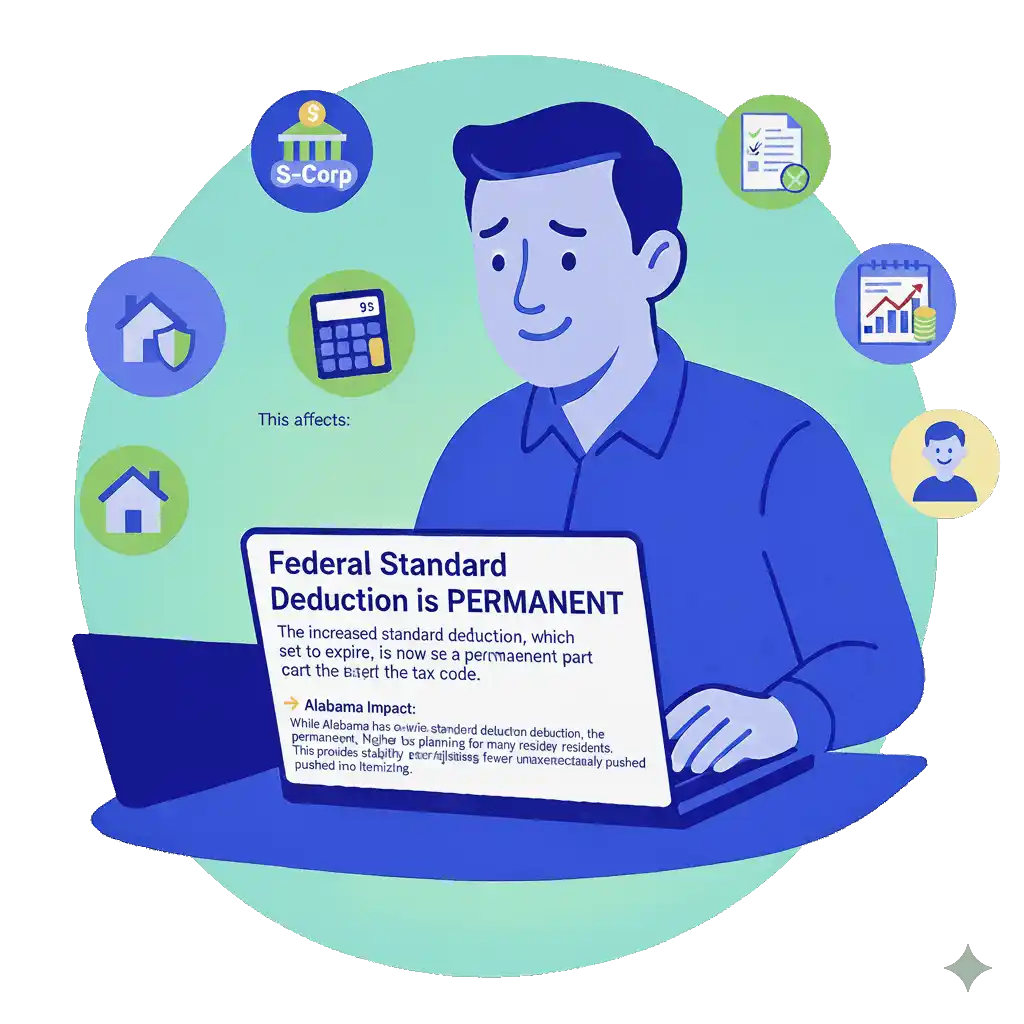
Federal Standard Deduction is PERMANENT
The increased standard deduction, which was set to expire, is now a permanent part of the tax code.
👉 Alabama Impact
While Alabama has its own standard deduction, the permanent, higher federal deduction simplifies tax planning for many residents. This provides stability and predictability, ensuring fewer Alabamians are unexpectedly pushed into itemizing.
Lower Federal Tax Brackets are PERMANENT
The lower individual income tax rates from the TCJA are also here to stay
👉 Alabama Impact
This is great news for Alabama families and professionals. Those in the $75k-$300k income range, including Huntsville’s tech professionals, Birmingham’s medical community, and small business owners statewide, will avoid the previously anticipated tax bracket increases. Your federal tax liability will remain lower than pre-TCJA levels.
The QBI Deduction is PERMANENT and ENHANCED
Contrary to previous expectations, the 20% Qualified Business Income (QBI) Deduction is not ending. OBBBA made it permanent and even improved it
This is a game-changer for Alabama’s:
- LLCs
- S-Corps
- Sole Proprietors
- Partnerships
Key OBBBA Enhancements to QBI:
- Permanence: The 20% deduction is locked in for 2026 and
- Minimum Deduction: A new $400 minimum deduction is available for businesses with at least $1,000 in qualified
- Expanded Phase-Outs: The income phase-out ranges for Specified Service Trades or Businesses (SSTBs) have been increased, allowing more professionals in fields like healthcare, law, and finance to claim the
Alabama Impact:
This is a massive win for Alabama’s small business community. A business earning $150,000 that was expecting to lose this deduction will now keep it, saving thousands in federal taxes annually. S-Corp and LLC structuring remains a critical strategy
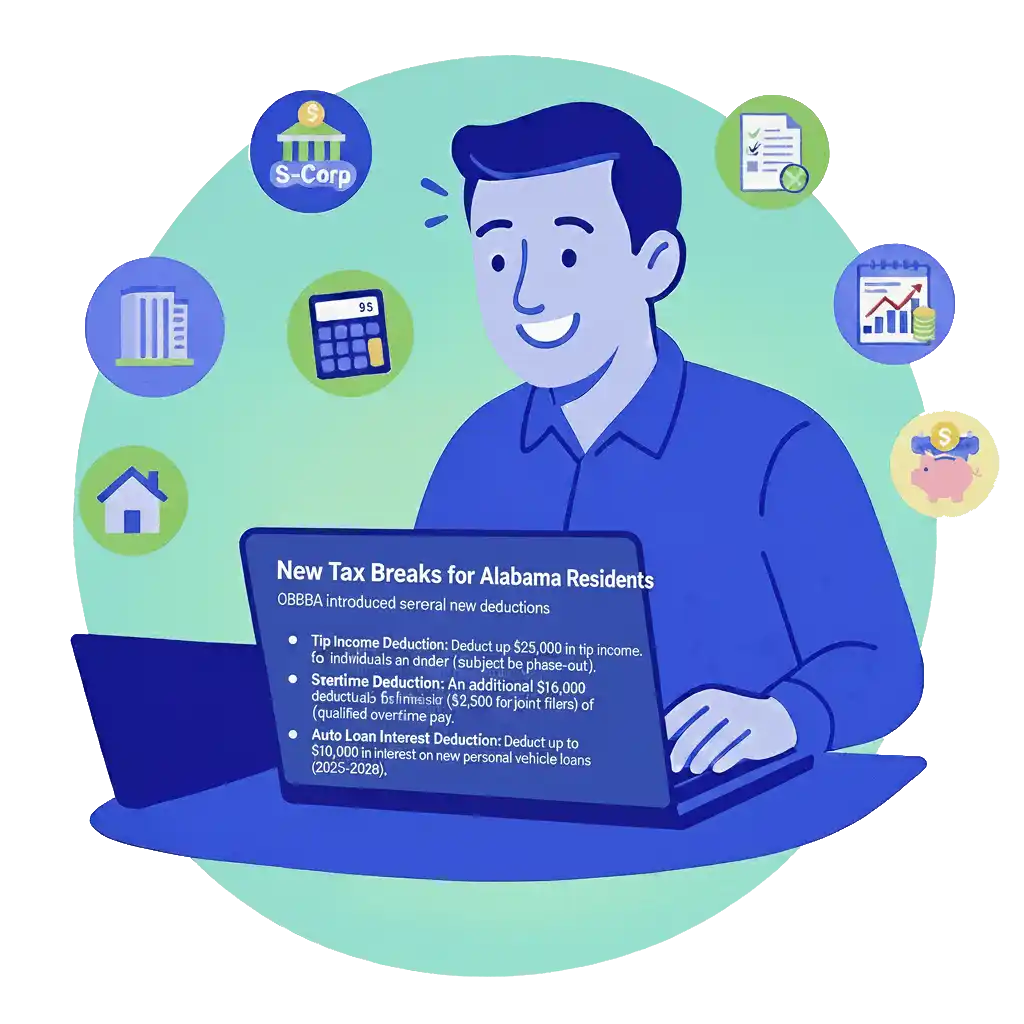
New Tax Breaks for Alabama Residents
OBBBA introduced several new deductions that will benefit many in Alabama:
- Tip Income Deduction: Deduct up to $25,000in tip
- Senior Deduction: An additional $6,000 deduction for individuals 65 and older (subject to phase-out).
- Overtime Deduction: Deduct up to $12,500 ($25,000 for joint filers) of qualified overtime
- Auto Loan Interest Deduction: Deduct up to $10,000 in interest on new personal vehicle loans (2025-2028).
Alabama-Specific Considerations for 2026
Alabama Income Tax Brackets Remain
Alabama’s state income tax brackets (2%, 4%, 5%) are separate from the federal system. Your total tax liability is a combination of your permanent federal tax rate and Alabama’s state tax rate.
Alabama & Federal Conformity
Alabama conforms to the federal tax code on a rolling basis, but with exceptions.This means that while many OBBBA provisions will flow through, specific areas like bonus depreciation and certain real estate strategies require careful state-level planning to ensure you are not overpaying.
Real Estate & STR (Short-Term Rental) Changes
For investors in Gulf Shores, Orange Beach, and Huntsville, OBBBA solidifies key real estate provisions. 100% bonus depreciation is now permanent, allowing for immediate expensing
of qualified property. This makes cost segregation and strategic asset acquisition more
powerful than ever. Careful planning around passive vs. active income classification for STRs remains critical.
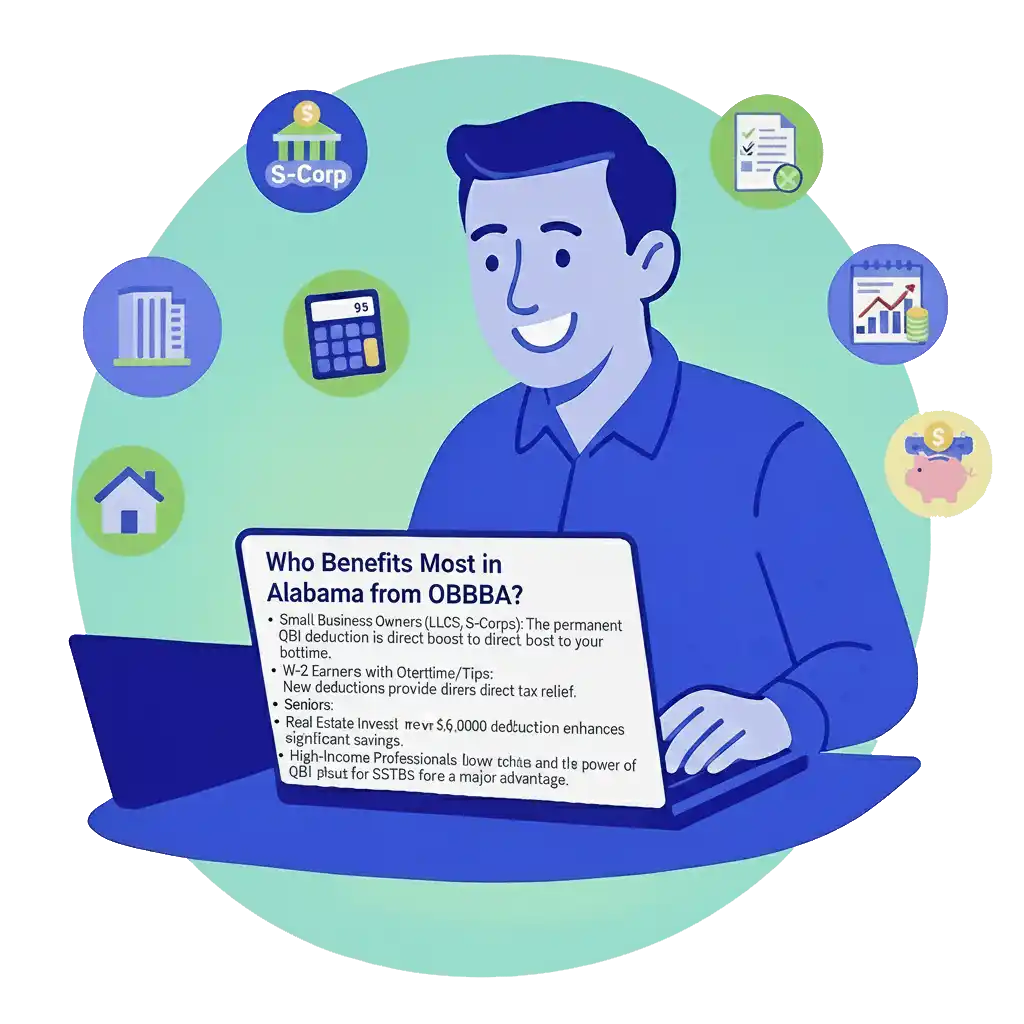
Who Benefits Most in Alabama from OBBBA?
- Small Business Owners (LLCs, S-Corps): The permanent QBI deduction is a direct boost to your bottom line.
- W-2 Earners with Overtime/Tips New deductions provide direct tax relief.
- Seniors: The new $6,000 deduction offers significant savings.
- Real Estate Investors: Permanent 100% bonus depreciation enhances the power of real estate investment.
- High-Income Professionals: Permanent lower tax brackets and expanded QBI phase- outs for SSTBs are a major advantage.
What Alabama Taxpayers Should Do Now
- Re-evaluate Your Tax Plan Your old plan based on TCJA expiration is now obsolete. It's time for a new strategy based on permanence.
- Review Your Business Entity: With QBI permanent, is your current structure (LLC, S- Corp) still the most tax-efficient?
- Maximize New Deductions: Plan to take full advantage of the new tip, overtime, and senior deductions in 2026.
- Accelerate Investments: Leverage the permanent 100% bonus depreciation for any planned equipment or property purchases.

Alabama 2026 Tax FAQ
Are Alabama taxes going up in 2026?
State rates don’t change — but federal changes make your total tax bill higher.
Will Alabama homeowners pay more?
Yes — itemizing becomes more common, and SALT limitations affect mortgage-heavy households.
Do Alabama STR operators (Airbnb) get impacted?
Yes. STR rules + depreciation changes matter a LOT in 2026.
Should Alabama LLCs switch to S-Corp before 2026?
If your net income is $60K–$150K, probably yes — before QBI drops.
Will my paycheck be smaller?
Yes — higher brackets = less take-home.
Get Your Personalized 2026 Alabama Tax Plan
The tax landscape has permanently shifted in your favor. Don’t operate on outdated assumptions. A personalized strategy session will ensure you are structured to maximize every new and permanent benefit under OBBBA.