
Iowa 2026 Tax Changes — What the One Big Beautiful Bill Act (OBBBA ) Means for Residents

On January 1, 2026, the federal tax landscape underwent a historic and positive transformation. The One Big Beautiful Bill Act (OBBBA), signed into law on July 4, 2025, made permanent many of the major tax cuts from the 2017 Tax Cuts and Jobs Act (TCJA) and introduced new benefits for taxpayers. The long-feared 2026 “tax cliff” has been avoided.
For Iowans, this is exceptionally good news. As Iowa transitions to a low, flat state income tax, these permanent federal changes provide a powerful one-two punch of tax relief. This guide provides a clear, localized breakdown of how the permanent tax laws under OBBBA will impact your income, business, and financial strategy in 2026 and beyond.
Federal Changes Bring Relief to Iowa Taxpayers
While Iowa has its own state tax system, your federal tax bill is a major part of your overall financial picture. OBBBA has made that picture much brighter.
Lower Federal Tax Brackets are PERMANENT
The biggest news is that the lower individual income tax rates from the TCJA are now permanent. The anticipated jump in federal tax rates has been avoided
Iowa Impact:
This is a crucial win for Iowa’s working families. For professionals in Des Moines and Cedar Rapids, workers in the state’s robust manufacturing and agricultural sectors, and dual-income households in growing suburbs, having lower, predictable federal tax rates provides much-needed financial stability.
The Federal Standard Deduction is PERMANENT
The higher federal standard deduction, which simplifies tax filing for millions, is also here to stay.
Iowa Impact:
A permanent, higher federal standard deduction is a direct benefit for the majority of Iowans. It provides a substantial, straightforward deduction on your federal return, lowering your taxable income without the need for complex itemization.
The QBI Deduction is PERMANENT and ENHANCED (Federal Level)
This is the most critical update for Iowa’s business and agricultural community. The 20% Qualified Business Income (QBI) Deduction is not expiring. OBBBA has made it a permanent part of the federal tax code and even improved it.
Important Note for Iowa:
- While Iowa is phasing in its own tax cuts, it does not offer a state- level QBI deduction. However, this powerful 20% deduction remains fully available on your federal tax return.
This is a major federal benefit for Iowa’s:
- Farmers, ranchers, and agricultural businesses
- LLCs, S-Corps, and Sole Proprietors
- Real estate investors and landlords
- Independent contractors and gig economy workers
Key OBBBA Enhancements to QBI:
- Permanence: The 20% The 20% federal deduction is locked in for 2026 and beyond.
- Minimum Deduction : A new $400 minimum federal deduction is available for any business with at least $1,000 of qualified income.
Iowa Impact:
This is a massive win for the state’s thriving small business and agricultural ecosystem. For the thousands of farms and main street businesses that are the backbone of Iowa’s economy, the permanent federal QBI deduction provides tens of thousands of dollars in annual tax savings, fueling further investment and growth.

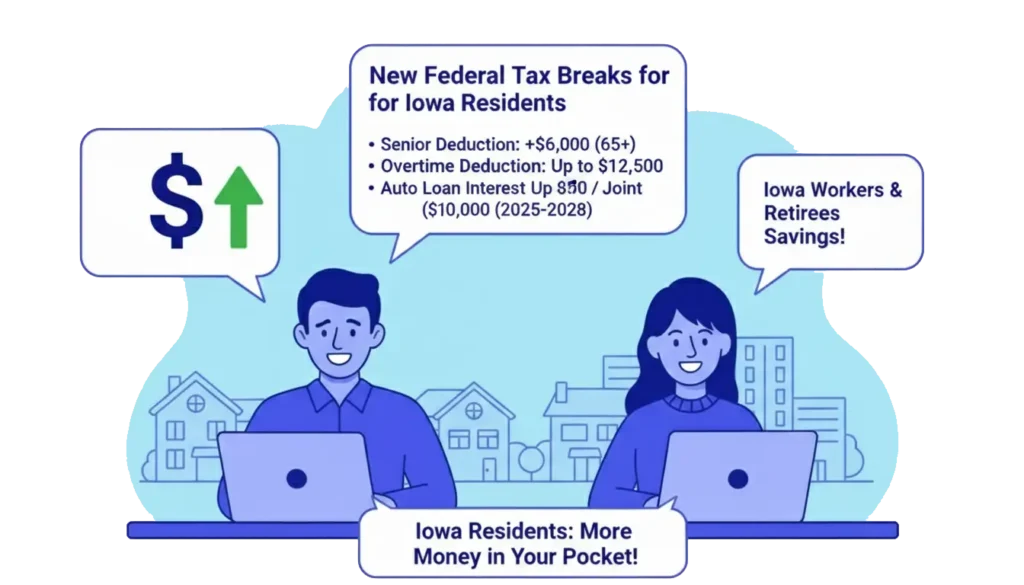
New Federal Tax Breaks for Iowa Residents
OBBBA also introduced several new federal deductions that will directly benefit many in Iowa:
- Senior Deduction: An additional $6,000 deduction for individuals 65 and older, providing federal tax relief for Iowa’s retirees (subject to phase-out).
- Overtime Deduction: Deduct up to $12,500 ($25,000 for joint filers) of qualified overtime pay, a significant benefit for Iowa’s manufacturing and agricultural workers.
- Auto Loan Interest Deduction: Deduct up to $10,000 in interest on new personal vehicle loans from 2025-2028
Iowa-Specific Tax Considerations for 2026
Iowa’s Transition to a Flat Tax
By 2026, Iowa will have a single, flat individual income tax rate of 3.9%.This major state-level tax cut, combined with the permanent federal tax cuts under OBBBA, creates a highly favorable tax environment for Iowans. Because Iowa uses federal AGI as a starting point, the permanent federal deductions help keep your AGI lower, which in turn reduces your state tax liability.
Farm Income and Agricultural Businesses
For Iowa’s massive agricultural sector, OBBBA provides stability. The permanence of the federal QBI deduction and 100% bonus depreciation for qualified property allows for better long-term planning around equipment purchases and operational investments. federal certainty complements Iowa’s state-level tax reforms, creating a supportive environment for farm families and related businesses.
Retirement Income in Iowa
Starting in 2023, Iowa fully exempted retirement income from the state income tax for
eligible taxpayers. This powerful state-level benefit is now amplified by the permanent
lower federal tax rates under OBBBA, making Iowa an even more attractive state for retirees from a tax perspective.
What Iowa Taxpayers Should Do Now
- UpdateYour Tax Plan: Your old strategy, based on the fear of expiring tax cuts, is It’s time to build a new plan based on permanence and new federal opportunities.
- Integrate Federal and State Planning: Work with a professional who understands how to maximize permanent federal benefits while navigating Iowa’s new flat tax system.
- Maximize the Federal QBI Deduction: If you own a farm or business, ensure your structure and bookkeeping are optimized to claim the full 20% federal QBI
- LeverageReal Estate Benefits: Plan your real estate investments to take full advantage of permanent 100% bonus depreciation on your federal return.

Iowa 2026 Tax FAQ
Does Iowa conform to QBI?
Not fully. QBI is federal-only.
Will Iowa taxes rise in 2026?
Rates may not change, but taxable income can rise due to federal changes.
Are families impacted?
Yes — reduced credits and higher taxable income affect many households.
Are STR owners affected?
Yes — depreciation and rental classification rules tighten.
Are retirees affected?
Yes — federal tax changes impact retirement income withdrawals.
Get Your Personalized 2026 Iowa Tax Plan
The tax landscape has permanently shifted in your favor. Don’t operate on outdated assumptions. A personalized strategy session will ensure you are structured to maximize every new and permanent benefit under OBBBA, fully integrated with Iowa’s new state tax laws.
Because tax situations vary by individual and business, many Iowa residents choose to work with a qualified tax professional. You can explore available Iowa tax services here: