
Idaho 2026 Tax Changes — What the One Big Beautiful Bill Act (OBBBA ) Means for Residents

On January 1,2026, the federal tax landscape underwent a historic and positive transformation. The One Big Beautiful Bill Act (OBBBA), signed into law on July 4, 2025, made permanent many of the major tax cuts from the Tax Cuts and Jobs Act (TCJA) and introduced new benefits for taxpayers. The long-feared 2026 “tax cliff” has been avoided.
For Idaho residents, this is exceptionally good news. While Idaho has its own flat state income tax, these permanent federal changes significantly enhance your financial outlook. This guide provides a clear, localized breakdown of how the permanent tax laws under OBBBA will impact your income, business, and financial strategy in 2026 and beyond.
Idaho Tax Planning You Can Trust

Guaranteed Strategy Backed by IRS Code:
Our analysis is based directly on the permanent federal tax code established by OBBBA.

Maximum Savings Promise:
If we miss a legal strategy that could lower your federal or state tax liability, we will redo your plan for free.

100% Accuracy Guarantee:
Every plan is reviewed by a licensed MERNA™ strategist who understands Idaho’s unique economic landscape, from its flat state tax to its booming real estate and agricultural sectors.
What’s Actually Changing in 2026 — The Idaho OBBBA Update
The narrative of expiring tax cuts is over. OBBBA has locked in major benefits and added new ones. Here’s what Idaho residents need to know.
Federal Standard Deduction is PERMANENT
The higher federal standard deduction is now a permanent feature of the tax code, providing stability and simplifying tax filing for millions.
👉 Idaho Impact: A permanent, higher federal standard deduction is a direct benefit for the majority of Idaho residents. It provides a substantial, straightforward deduction on your federal return, lowering your taxable income without the need for complex itemization.
👉 Idaho Impact: This is excellent news for Idaho’s diverse workforce, including those in the booming construction and trade sectors, healthcare professionals in Boise and Idaho Falls, and families across the Treasure Valley. Households earning between $60,000 and $250,000 will avoid the significant tax increases they were previously expecting.
The QBI Deduction is PERMANENT and ENHANCED
This is the most critical update for Idaho’s business community. The 20% Qualified Business Income (QBI) Deduction is not expiring. OBBBA has made it a permanent part of the tax code and even improved it.
- LLCs, S-Corps, and Sole Proprietors
- Farmers, ranchers, and agricultural businesses
- Real estate professionals and investors
- Construction and trade contractors
- Permanence: The 20% deduction is locked in for 2026 and all future years.
- Minimum Deduction: A new $400 minimum deduction is now available for any business with at least $1,000 of qualified income.
- Expanded Phase-Outs: The income limitations for Specified Service Trades or Businesses (SSTBs) have been expanded, allowing more professionals to claim this valuable deduction.
👉 Idaho Impact: This is a massive win for the state’s thriving small business ecosystem. From farmers and ranchers to the booming construction trade, the permanent QBI deduction provides tens of thousands of dollars in annual tax savings, fueling further investment and growth.
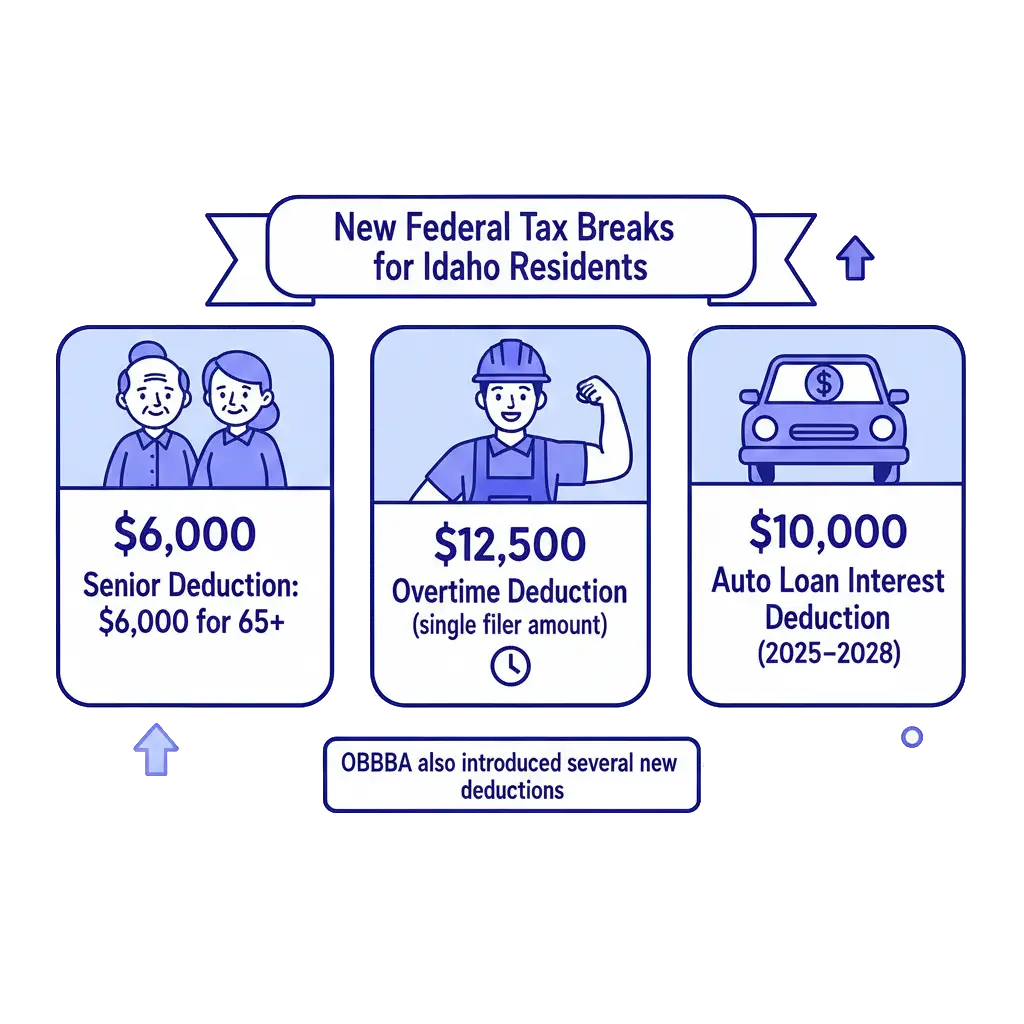
New Federal Tax Breaks for Idaho Residents
- Senior Deduction: An additional $6,000 deduction for individuals 65 and older, providing relief for Idaho’s growing retiree population (subject to phase-out).
- Overtime Deduction: Deduct up to $12,500 ($25,000 for joint filers) of qualified overtime pay, a significant benefit for Idaho's skilled trades and industrial workers.
- Auto Loan Interest Deduction: Deduct up to $10,000 in interest on new personal vehicle loans from 2025-2028.
Idaho-Specific Considerations for 2026
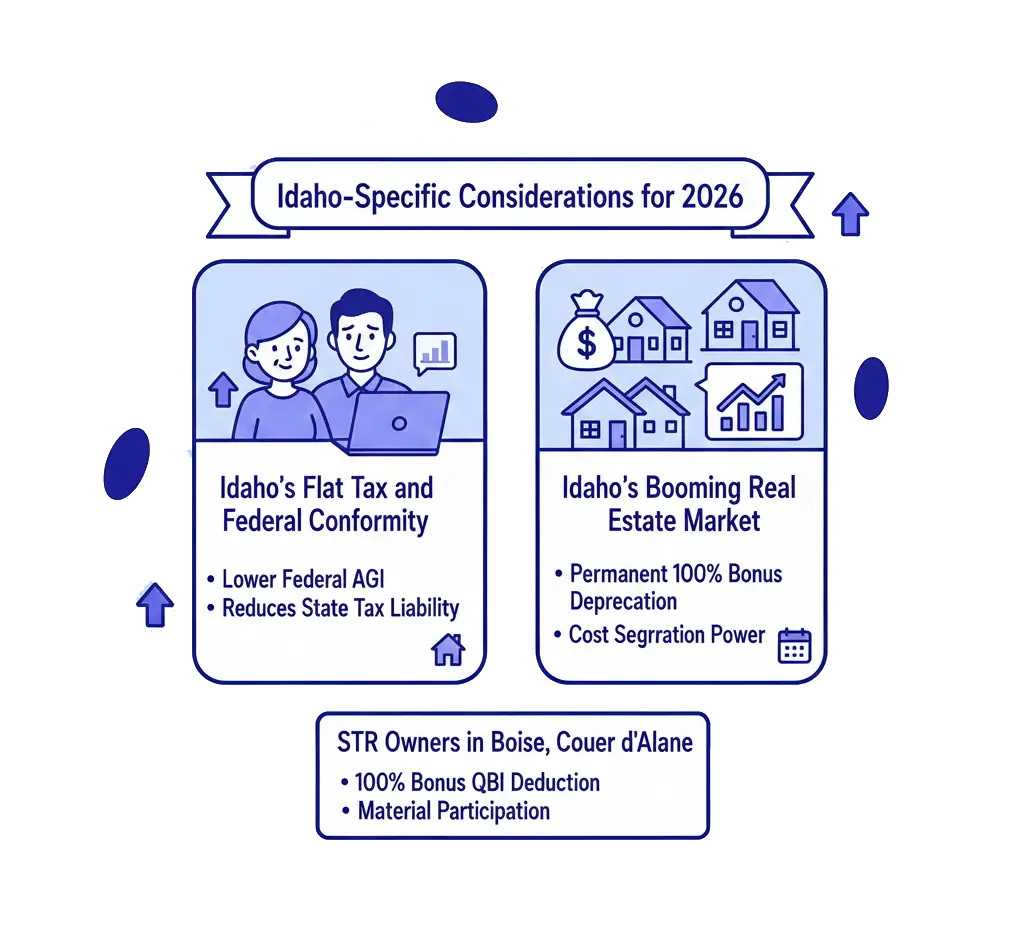
Idaho has a competitive flat state income tax. Because Idaho uses federal Adjusted Gross Income (AGI) as the starting point for state taxes, the permanent federal deductions under OBBBA help keep your AGI lower, which in turn can reduce your state tax liability. Idaho generally conforms to the Internal Revenue Code, meaning many of these federal benefits will flow through to your state return.
Idaho’s Booming Real Estate Market
For property owners in hot markets like Boise, Coeur d’Alene, and the Treasure Valley, OBBBA brings welcome news. The 100% bonus depreciation for qualified property is now permanent. This allows real estate investors to immediately write off the cost of certain assets, making strategies like cost segregation incredibly powerful. With Idaho’s real estate market poised for continued growth, timing property sales and managing capital gains exposure remains a critical planning point.
What Idaho Taxpayers Should Do Now
- Update Your Tax Strategy: Your old plan, based on the assumption of expiring tax cuts, is now obsolete. It’s time to build a new strategy based on permanence and new opportunities.
- Review Your Business Structure: With the QBI deduction now permanent, is your current entity (LLC, S-Corp, Sole Proprietorship) still the most tax-efficient choice for your goals?
- Plan for New Deductions: Strategize how to maximize the new senior and overtime deductions starting in 2026.
- Leverage Real Estate Benefits: With permanent 100% bonus depreciation, now is the time to evaluate real estate investments and cost segregation studies.

Idaho 2026 Tax FAQ
Does Idaho conform to QBI?
Not fully. QBI remains federal-only.
Will Idaho taxes go up?
State tax rates do not change, but taxable income may rise due to federal adjustments.
Are families affected?
Yes — credits shrink and federal taxable income increases.
Are retirees impacted?
Yes — federal brackets and IRA withdrawal taxation increase their total tax burden.
Are STR owners affected?
Yes — depreciation and rental participation rules change.
Get Your Personalized 2026 Idaho Tax Plan
The tax landscape has permanently shifted in your favor. Don’t operate on outdated assumptions. A personalized strategy session will ensure you are structured to maximize every new and permanent benefit under OBBBA.
Because tax situations vary by individual and business, many Idaho residents choose to work with a qualified tax professional. You can explore available Idaho tax services here: