
Arizona 2026 Tax Changes — What the One Big Beautiful Bill Act (OBBBA ) Means for You

On January 1, 2026, the federal tax landscape undergoes a historic and positive transformation. The One Big Beautiful Bill Act (OBBBA), signed into law on July 4, 2025, has made permanent many of the major tax cuts from the Tax Cuts and Jobs Act (TCJA) and introduced new benefits for taxpayers. This is a significant shift from the long-expected 2026 “tax cliff.”
Because tax situations vary by individual and business, many Arizona residents choose to work with a qualified tax professional. You can explore available Arizona tax services and professionals by location and specialty.
For every Arizona resident—from W-2 earners in Phoenix and Tucson to retirees in Sun City and business owners in Scottsdale—these changes are overwhelmingly positive. This guide provides a clear, localized breakdown of how the permanent tax laws under OBBBA will impact your income, business, and financial strategy in 2026 and beyond.

Guaranteed Strategy Backed by IRS Code
Our analysis is based directly on the permanent federal tax code established by OBBBA.

Maximum Savings Promise
If we miss a legal strategy that could lower your federal or state tax liability, we will redo your plan for free.

100% Accuracy Guarantee
Every plan is reviewed by a licensed MERNA™ strategist who understands Arizona’s unique economic landscape, from its flat state tax to its booming real estate markets.
What’s Actually Changing in 2026 — The Arizona OBBBA Update
Federal Standard Deduction is PERMANENT
While Arizona has its own standard deduction, the permanent, higher federal deduction is a significant benefit. It ensures that fewer Arizonans, especially homeowners in high-cost-of-living areas like Scottsdale and Chandler, will be forced into the complexity of itemizing deductions. This provides a stable foundation for tax planning.

Lower Federal Tax Brackets are PERMANENT
Arizona Impact
The QBI Deduction is PERMANENT and ENHANCED
- LLCs, S-Corps, and Sole Proprietors
- Real estate professionals and investors
- Construction and trade contractors
- High-income consultants and service providers
Key OBBBA Enhancements to QBI:
- Permanence: The 20% deduction is locked in for 2026 and all future years.
- Minimum Deduction: A new $400 minimum deduction is now available for any business with at least $1,000 of qualified income.
- Expanded Phase-Outs: The income limitations for Specified Service Trades or Businesses (SSTBs) have been expanded, allowing more professionals in fields like healthcare, law, and consulting to claim this valuable deduction.
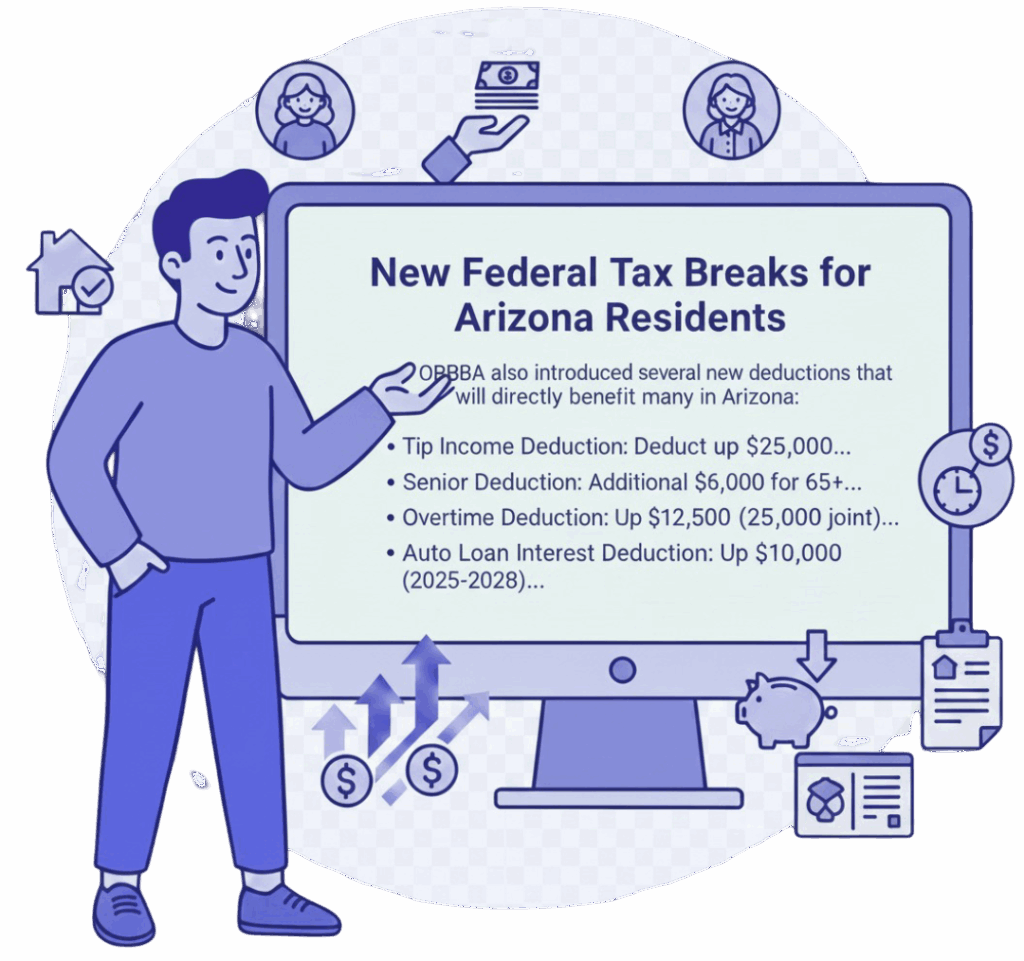
New Federal Tax Breaks for Arizona Residents
- Tip Income Deduction: Deduct up to $25,000 in tip income—a significant benefit for Arizona's large hospitality sector.
- Senior Deduction: An additional $6,000 deduction for individuals 65 and older, providing relief for Arizona’s large retiree population in communities like Sun City and Green Valley (subject to phase-out).
- Overtime Deduction: Deduct up to $12,500 ($25,000 for joint filers) of qualified overtime pay.
- Auto Loan Interest Deduction: Deduct up to $10,000 in interest on new personal vehicle loans from 2025-2028
Arizona-Specific Considerations for 2026
Arizona’s Flat Tax and Federal Conformity
Arizona’s Booming Real Estate Market
For property owners in hot markets like Phoenix, Scottsdale, and Flagstaff, OBBBA brings welcome news. The 100% bonus depreciation for qualified property is now permanent. This allows real estate investors to immediately write off the cost of certain assets, making strategies like cost segregation incredibly powerful. With Arizona’s real estate market poised for continued growth in 2026, timing property sales and managing capital gains exposure remains a critical planning point.
STR Owners in Scottsdale, Sedona, and Flagstaff

What Arizona Taxpayers Should Do Now
- Update Your Tax Strategy: Your old plan, based on the assumption of expiring tax cuts, is now obsolete. It’s time to build a new strategy based on permanence and new opportunities.
- Review Your Business Structure: With the QBI deduction now permanent, is your current entity (LLC, S-Corp, Sole Proprietorship) still the most tax-efficient choice for your goals?
- Plan for New Deductions: Strategize how to maximize the new tip, overtime, and senior deductions starting in 2026.
- Leverage Real Estate Benefits: With permanent 100% bonus depreciation, now is the time to evaluate real estate investments and cost segregation studies.

Arizona 2026 Tax FAQ
Are Arizona state taxes going up in 2026?
No — the rate is not changing, but your taxable income may increase.
Is QBI still available in 2026?
Yes. QBI is now permanent, but threshold and documentation rules change.
Does the Child Tax Credit shrink?
Yes — roughly cuts in half.
Are STR owners in Arizona affected?
Extremely — depreciation, QBI qualification, and participation rules get tighter.
Will my paycheck be smaller in 2026?
For many Arizonans, yes — due to bracket increases.